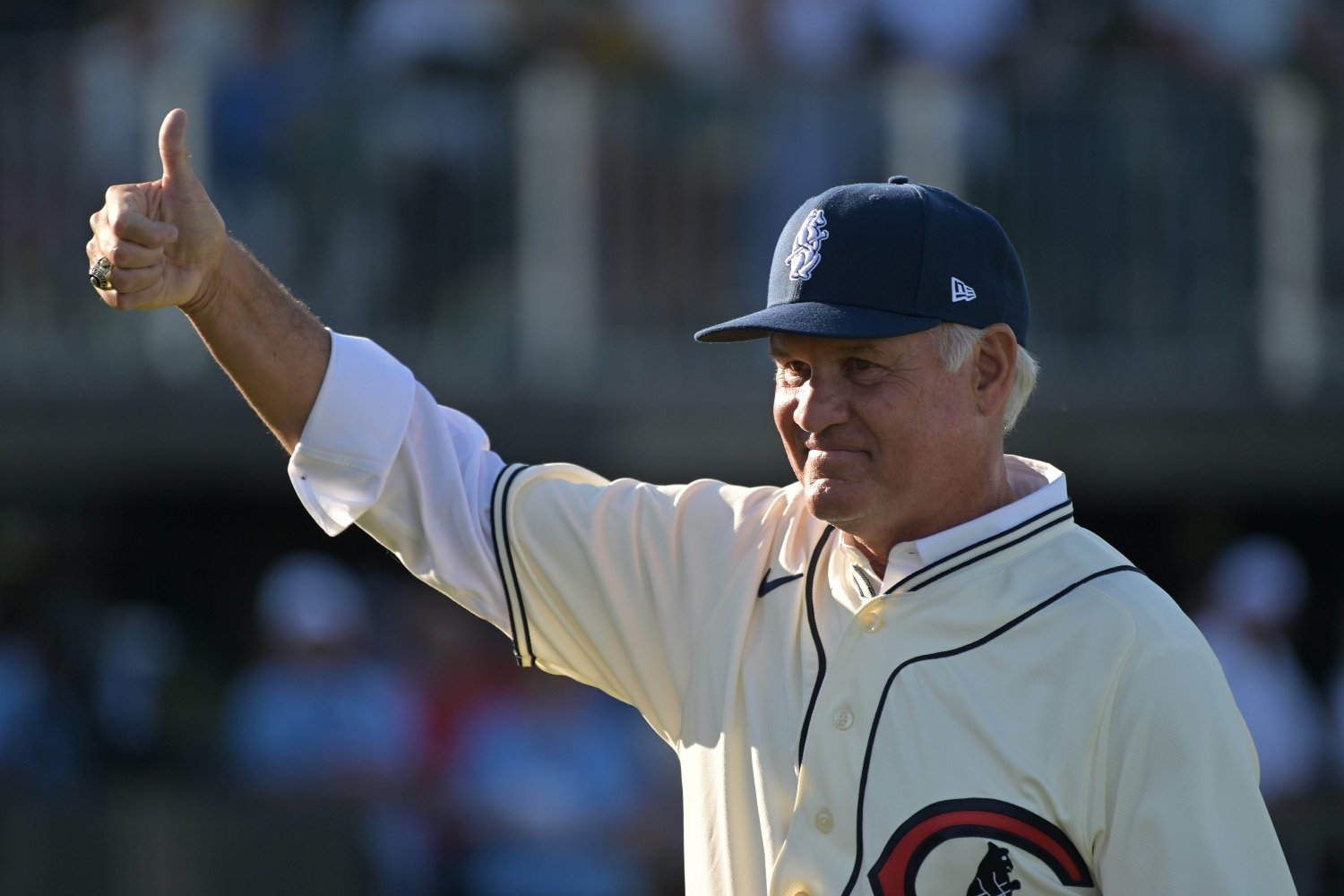
The Eternal Standard: Why Ryne Sandberg Still Defines What It Means to Be a Chicago Cub
On a summer afternoon at Wrigley Field, the crowd still chants his name. Not in unison, not orchestrated, but in whispers of nostalgia — a fan pointing to the retired number on the foul pole, a father telling his son about the player who once seemed larger than life, a vendor recalling the thunder of the bleachers every time he stepped into the batter’s box. Ryne Sandberg may have last worn a Chicago Cubs uniform three decades ago, but the essence of who he was — and what he meant — remains stitched into the very fabric of the franchise.
For the Cubs, who have known both heartbreak and triumph across generations, Sandberg is not simply a Hall of Famer. He is the eternal standard. The one who showed, with quiet resolve and unshakable consistency, what it truly meant to be a Chicago Cub.
A Career Forged in Silence, Built on Greatness
Sandberg was not loud. He was not flamboyant. He did not demand the spotlight. Instead, he let his glove, his bat, and his grit speak for him. When he arrived in Chicago in 1982 after a trade with Philadelphia, no one expected a franchise cornerstone. By 1984, he was the National League MVP, leading the Cubs to their first postseason in 39 years.
That season — punctuated by what is still called “The Sandberg Game” on June 23, when he hit two game-tying home runs off Hall of Famer Bruce Sutter on national television — was more than a breakout. It was an announcement. A declaration that Ryne Sandberg was the heartbeat of the Cubs and would be for years to come.
But his greatness did not lie in one game or one year. It was in the accumulation of excellence. Nine Gold Gloves. Seven Silver Sluggers. Ten All-Star appearances. A career batting average of .285 with 282 home runs, remarkable for a second baseman in his era. Sandberg transformed the position, proving that a middle infielder could be both a defensive wizard and a power threat.
The Blueprint for Generations
To understand Sandberg’s legacy, you have to understand Chicago. The Cubs are more than a baseball team; they are a cultural institution, a generational bond. And for decades, fans pointed to Sandberg as the definition of what a Cub should be — disciplined, hardworking, resilient in the face of defeat, gracious in the face of victory.
Children who grew up in the 1980s wore number 23 jerseys not because it was flashy, but because it represented excellence. It represented the dream of playing the game the right way. Sandberg wasn’t just an athlete — he was a role model.
When players like Kris Bryant, Javier Báez, or even Anthony Rizzo came to Wrigley in later years, Sandberg’s influence lingered in the clubhouse. His image on the walls. His quiet standard of professionalism. His expectation that wearing “Cubs” across your chest meant more than statistics — it meant responsibility.
The Retirement That Shocked, and the Return That Inspired
Sandberg’s story is not without drama. In 1994, at the height of his career, he shocked the baseball world by retiring suddenly, citing a loss of passion for the game. For fans, it was like losing a compass. The man who had defined stability and dependability was gone, seemingly overnight.
But true to his resilient nature, Sandberg returned in 1996, rekindling his love for baseball and reminding everyone that legacies are not defined by absence, but by return. Though the Cubs of that era were not contenders, his presence alone steadied the team, and his final years became a farewell tour for fans who wanted to say goodbye properly.
When he retired for good in 1997, it was not an ending. It was the beginning of myth.
Hall of Fame, and Beyond
In 2005, Sandberg was inducted into the Baseball Hall of Fame, immortalized not just as one of the greatest second basemen of all time, but as a symbol of Cubs history. His speech that day remains one of the most memorable in Cooperstown, where he spoke about respect — for the game, for teammates, for opponents, for fans. It was a message that mirrored the way he played every inning of his career.
The Cubs retired his number 23 in 2005 as well, ensuring that no future player would wear it. Hanging from the foul pole at Wrigley, that number is not simply digits. It is a reminder. A beacon. A silent promise that greatness has worn this uniform before, and greatness will be expected again.
Why Sandberg Still Matters Today
Why does Ryne Sandberg’s story resonate so deeply, even decades later? Because in an era defined by highlights and headlines, he proved that true legacy is built through character. He wasn’t brash. He wasn’t controversial. He was steady. And in his steadiness, he became eternal.
For modern fans, Sandberg is a bridge. He connects the heartbreak of pre-2016 Cubs baseball with the glory of that long-awaited championship. He represents the resilience of a franchise that endured and endured until, finally, it triumphed.
His standard still shapes the way Cubs players are judged. Is this player resilient? Is he committed to excellence day after day? Does he understand the weight of wearing this uniform? These are questions Sandberg answered not with words, but with decades of example.
The Legacy of Number 23
Today, when you walk into Wrigley Field, Sandberg’s presence lingers everywhere. The murals. The highlight reels. The memories carried by fans who lived through the 1980s and 1990s. Even young fans, who never saw him play, know his name. They know that number 23 is sacred — not just because it belonged to a Hall of Famer, but because it belongs to the eternal standard of what it means to be a Chicago Cub.
He remains the blueprint. The icon. The leader. The resilient Gold Glover who turned double plays with poetry and launched home runs with thunder. The man who, without shouting, told us everything we needed to know about greatness.
And so, long after his final swing, long after his final throw across the diamond, Ryne Sandberg is not gone. He is present. In the ivy. In the echoes. In the legacy of the Cubs themselves.
Because some players wear a number. Others give it meaning. Ryne Sandberg gave number 23 a legacy that will never fade.