In the high-stakes world of professional basketball, a single moment can change everything. A split-second decision, a routine play, or an unfortunate collision can alter the course of a game, a season, or even a career. For Indiana Fever’s Sophie Cunningham, that moment arrived on August 17th during a road game against the Connecticut Sun. A second-quarter collision with the Sun’s Bria Hartley resulted in a devastating diagnosis: a season-ending tear to her right MCL. While injuries are an unfortunate and all-too-common part of the sport, the aftermath of this particular incident spiraled into something far more complex. Fueled by a single, decontextualized image, a social-media firestorm erupted, casting one player as a villain and the other as a victim. However, the true story behind Sophie Cunningham’s Season-Ending Injury is not one of malice, but one of friendship, sportsmanship, and the dangerous speed at which online narratives can eclipse the truth. It’s a tale that forces us to look beyond the viral clips and angry comments to understand the human side of the athletes we watch.
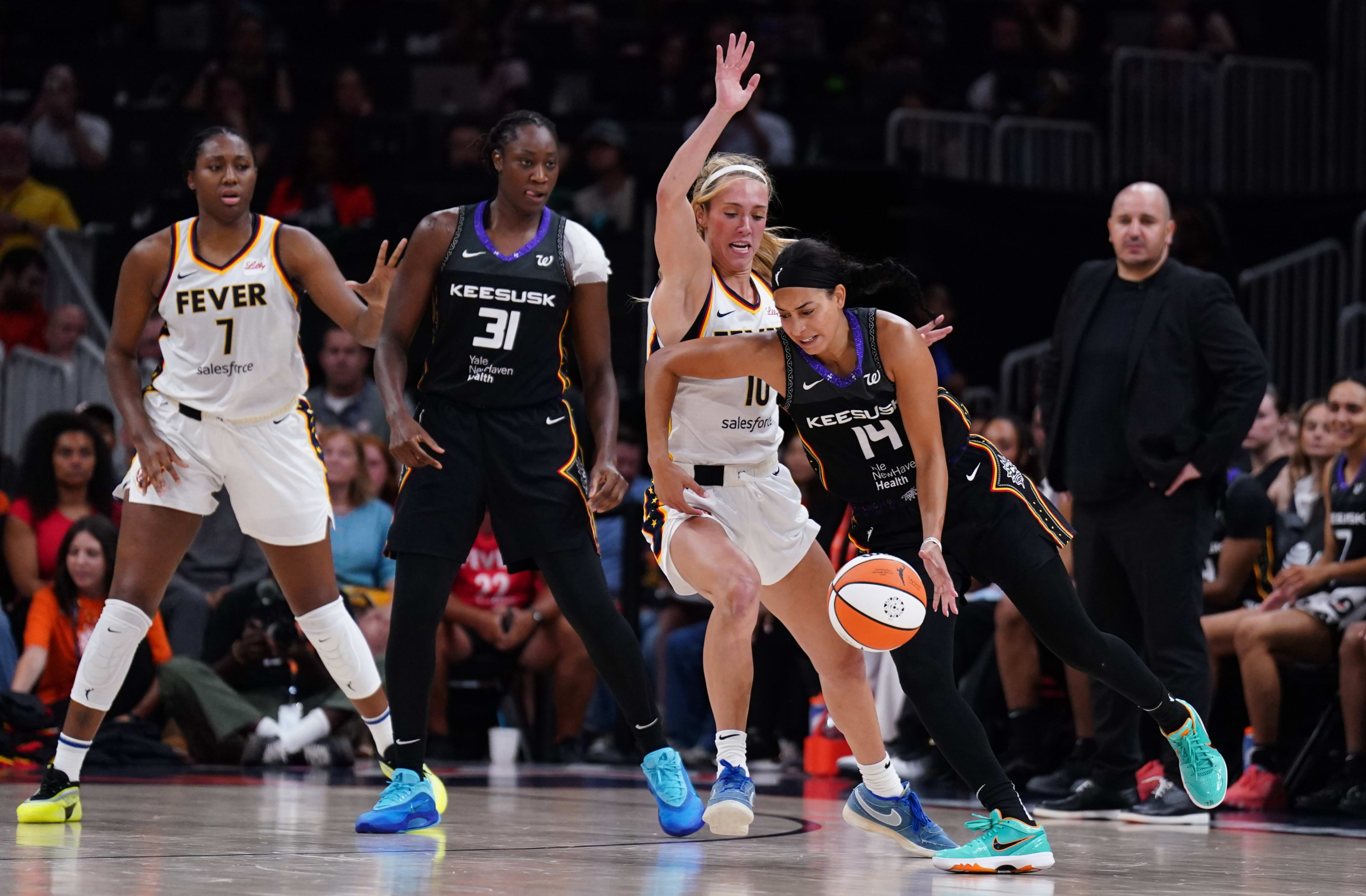
A Split-Second Collision with Lasting Consequences
The game was just another intense matchup in the WNBA calendar, with both the Indiana Fever and Connecticut Sun fighting for position. During the second quarter, a fast-moving play unfolded. As players scrambled for position, Connecticut’s Bria Hartley and Indiana’s Sophie Cunningham collided. On the surface, it looked like countless other physical encounters that happen in every game. But this time, the outcome was severe. Cunningham went down in pain, and the initial concern on the court soon turned into a grim reality. On August 19, just two days later, the Fever officially announced that Cunningham would miss the remainder of the season with a torn MCL. The news was a significant blow to the team, which relied heavily on her two-way contributions. Before the injury, Cunningham was a vital piece of the Fever’s puzzle, averaging 8.6 points, 3.5 rebounds, and 1.0 steals over 30 games, while shooting an impressive 43.2% from three-point range. Her absence left a void that the team had to scramble to fill, immediately signing Shey Peddy to a hardship contract.
When a Picture Ignites a Social-Media Firestorm
In today’s digital age, the on-court action is only half the story. As news of the injury spread, so did a particular image from the broadcast. The photo appeared to capture Bria Hartley smiling as Cunningham lay injured on the floor. In the court of public opinion, this single frame became irrefutable evidence of ill intent. Almost immediately, a social-media firestorm erupted.
The “Smile” Seen Around the WNBA World
Fans, armed with the viral image, flooded social media platforms with accusations. Hartley was branded as a dirty player who had intentionally injured an opponent and reveled in the outcome. The narrative was simple, powerful, and deeply damaging. Her comment sections on social media posts became a battleground, filled with angry messages and vitriol. The nuance of a fast-paced basketball game was lost, replaced by a black-and-white story of a hero and a villain. It was a stark reminder of how quickly online mobs can form and how a single, out-of-context moment can threaten to define a professional athlete’s reputation. The pressure became so intense that Hartley was forced to take action to protect her own mental well-being from the relentless digital onslaught.
Bria Hartley Breaks Her Silence
Caught in the crosshairs of intense public scrutiny, Bria Hartley eventually addressed the situation on an episode of the “Good Follow” podcast. Her account painted a picture starkly different from the one being circulated online. She explained that the collision was a complete accident and that her focus was entirely elsewhere during the sequence. Hartley stated she was looking to make a corner pass and that a steal by Lexie Hull completely changed the dynamics of the play. “I didn’t even realize that I hit Sophie in the moment,” Hartley recounted. “I was thinking it was Kelsey Mitchell and then, when I got back up, I saw she was down.” She addressed the viral image, clarifying that any expression she had was not directed at Cunningham’s misfortune. The reality of the situation, she explained, was far from the malicious act fans had imagined. Speaking on the backlash, she added, “After that, though, there was a lot of messages. You know how fans are. People are going to have their narratives. People are going to say what they want. But you see it all. It’s hard not to see it… There was a point where I turned off my comments.”
Sophie Cunningham Defends Her Friend and Opponent
Just as the narrative against Hartley seemed to be cementing, a powerful and unexpected voice emerged in her defense: Sophie Cunningham herself. Speaking on her own podcast, “Show Me Something,” Cunningham swiftly and decisively dismantled the accusations against Hartley. She revealed a crucial piece of information that the online critics had missed—she and Hartley are not just competitors, but close friends. “I know Bria, and I’m actually really good friends with Bria… I don’t think that there was any ill intent,” Cunningham stated unequivocally. She described the incident as nothing more than a basketball play gone wrong. “I think it was a basketball play, I was just in the wrong spot at the wrong time, she fell. Like, there’s no way she would go in there and intentionally try to hurt me.” Cunningham didn’t stop there. She made a direct plea to the fans who had been attacking Hartley online. “I have nothing but love for Bria… Bria and I are super cool, and she would never try to hurt me… I hope people stop giving Bria some heat, because I don’t think she meant to do that at all,” she added. Her words served as a powerful testament to sportsmanship and friendship, cutting through the noise of the online hate campaign.
The Ripple Effect of Sophie Cunningham’s Season-Ending Injury
Beyond the personal drama and the online controversy, Sophie Cunningham’s Season-Ending Injury had tangible effects on the court. For the Indiana Fever, losing a key player like Cunningham was another challenge in an already difficult season. The team’s injury list was long, having also seen players like Caitlin Clark, Sydney Colson, Aari McDonald, and Chloe Bibby sidelined at various points. Yet, despite the adversity, the team showed incredible resilience. They finished the season with a 24-20 record, securing the No. 6 seed in the playoffs and positioning themselves for a potential run to the WNBA Finals for the first time since 2015. For her part, Bria Hartley was also a significant contributor for the Connecticut Sun, with a similar statistical output to Cunningham, averaging 8.9 points and 3.1 assists across 38 games. The incident served as a reminder of how interconnected the league is and how the absence of one player can have ripple effects across multiple teams.
The story of Sophie Cunningham’s injury and the ensuing controversy offers a powerful lesson for the modern sports world. It underscores the immense gap that can exist between a perceived reality shaped by a viral social media moment and the actual truth known by those involved. What began as a tragic on-court accident was twisted into a narrative of deliberate malice, fueled by a single image stripped of all context. The backlash faced by Bria Hartley was swift and severe, demonstrating the volatile nature of online fan culture. Yet, the most enduring part of this story is the incredible display of character from Sophie Cunningham. In a moment when she could have remained silent, she chose to speak out, defending her friend and opponent with grace and integrity. Her actions elevated the conversation from one of blame to one of sportsmanship and loyalty. Ultimately, the saga of Sophie Cunningham’s Season-Ending Injury is a reminder that behind every jersey is a human being, and behind every controversial basketball play is a story more complex than a single photo can ever tell.