U.S.–Canada Political Friction Grows as Trump and Carney Exchange Sharper Signals Over Sovereignty and Trade
Political tension between the United States and Canada has once again moved into the spotlight after renewed reports of sharp rhetoric between President Donald Trump and Canadian Prime Minister Mark Carney. While no official statement confirms that Trump directly urged Carney to step aside, recent public remarks and policy disputes have intensified debate about how far political language between two long-standing allies can go before it begins to influence real diplomatic outcomes.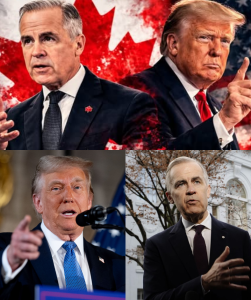
The latest wave of attention follows several months of increasingly public disagreement between Washington and Ottawa on issues ranging from tariffs to sovereignty, defense planning, and Canada’s efforts to diversify its international partnerships. What makes the current moment especially notable is that both leaders are speaking not only to each other, but also to domestic audiences that are closely watching how national interests are defended in an uncertain global climate.
Canadian officials reacted firmly in recent weeks whenever U.S. political language appeared to cross into sensitive territory involving sovereignty. Carney has repeatedly emphasized that Canada’s political decisions will remain independent, even while maintaining cooperation with the United States in trade and security. In January, he stated publicly that Canada expected full respect for its sovereignty while continuing discussions on economic agreements and regional stability.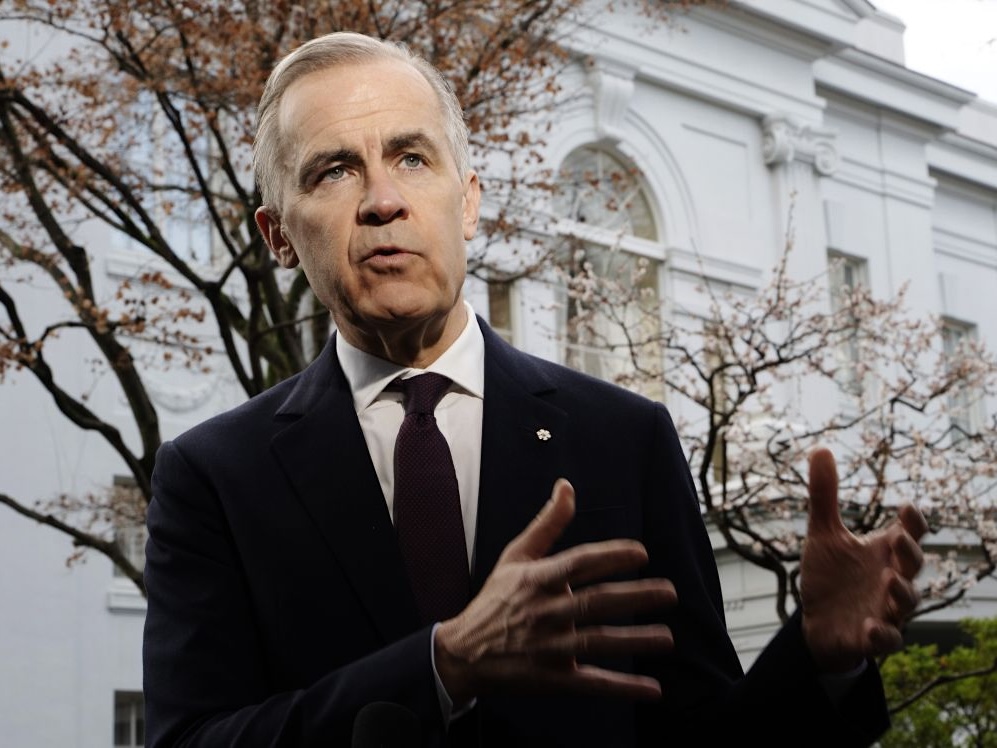
That statement came after renewed pressure linked to trade concerns involving China, where Washington warned that deeper Canadian tariff arrangements with Beijing could trigger stronger American responses. Carney answered by clarifying that Canada had no intention of entering a full free trade agreement with China, but he also made clear that Ottawa would continue protecting its own economic priorities rather than simply aligning with every U.S. demand.
Behind the public exchanges lies a broader strategic shift in Canada’s foreign policy. Under Carney’s leadership, Ottawa has accelerated efforts to reduce dependence on any single major partner by expanding trade relationships with other countries and strengthening domestic industrial policy. Analysts say this reflects a long-term calculation: Canada wants more negotiating flexibility in case future U.S. administrations impose sudden tariff changes or political conditions that disrupt key sectors.
The issue is particularly important because the economic relationship between the two countries remains one of the most integrated in the world. Every day, billions of dollars in goods move across the border, with automotive production, energy exports, food supply chains, and manufacturing systems tightly connected. Even minor policy disputes can quickly affect companies, workers, and investors on both sides of the border.
Recent defense decisions have added another layer to the discussion. Earlier this month, Carney announced a major investment package for Arctic defense infrastructure, arguing that Canada must strengthen its own northern capabilities in a period when global security assumptions are changing. The plan includes expanded airfields, transport routes, and logistical hubs across northern territories. Though officially framed as a sovereignty and defense modernization effort, many observers noted that the announcement also sends a message that Canada intends to rely less automatically on U.S. strategic protection in certain areas.
Trump, meanwhile, has continued using rhetoric that often blurs the line between negotiation pressure and political spectacle. In recent public remarks, he has referred to Canada in ways that many Canadian officials consider unnecessarily provocative, including comments suggesting Ottawa benefits disproportionately from the American economy. Carney responded by arguing that Canada’s strength comes from its own institutions, values, and economic resilience rather than dependence on Washington.
Foreign policy experts note that disagreements between allies are not unusual, but the tone matters because language can shape expectations before formal negotiations even begin. In this case, both governments are preparing for future trade reviews under the United States–Mexico–Canada framework, meaning each side is already positioning itself carefully.
There is also political calculation on both sides. Trump’s messaging often appeals to domestic voters who favor aggressive negotiation tactics, while Carney’s responses are designed to reassure Canadians that national sovereignty remains non-negotiable. This creates a situation where even symbolic exchanges receive outsized attention because they feed broader narratives about leadership and national control.
For now, diplomats in both capitals continue working behind the scenes to prevent public rhetoric from disrupting practical cooperation. Border security coordination, defense cooperation, and trade talks remain active, even as political headlines suggest confrontation.
What happens next may depend less on dramatic statements and more on whether both governments can maintain working relationships while managing growing differences in tone. The public language may be sharper than before, but the economic reality still pushes both countries toward cooperation—whether either side fully acknowledges it or not.