In the modern NFL, building a perennial championship contender requires a masterclass in roster construction. For the San Francisco 49ers, general manager John Lynch and head coach Kyle Shanahan have practically perfected the art of finding elite weapons, dominant defensive linemen, and cerebral linebackers. Yet, a glaring, borderline bizarre statistical anomaly hangs over Levi’s Stadium like a dark cloud.
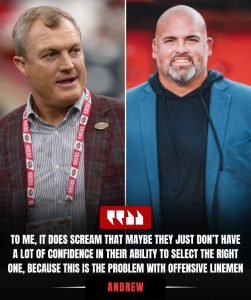
The last time the 49ers allocated a first- or second-round draft pick on an offensive lineman was all the way back in 2021, when they selected guard Aaron Banks. Since then? Total radio silence in the early rounds when it comes to protecting the trenches.
To many casual fans, this might look like a simple draft-board quirk or a philosophical commitment to value shopping. But to four-time Pro Bowl left tackle and Super Bowl champion Andrew Whitworth, this prolonged drought isn’t an accident at all. It screams something far more psychological, and far more damaging to the front office’s ego.
The Fear of the Draft Bust
Appearing on a recent football analysis segment, Whitworth didn’t hold back when analyzing San Francisco’s draft history. He believes the 49ers’ refusal to pull the trigger on elite, early-round blockers stems from a deep-seated insecurity within their scouting department.
“To me, it does scream that maybe they just don’t have a lot of confidence in their ability to select the right one,” Whitworth explained candidly.
Whitworth’s theory exposes the brutal, unforgiving reality of evaluating offensive linemen at the college level. On paper, everyone loves the theory of using a premium first- or second-round asset to anchor the line. It sounds gritty, smart, and fundamental. But as Whitworth points out, the margin for error at that position is razor-thin.
“This is the problem with offensive linemen: When you’re going to allocate a first-round pick or second-round pick to an offensive lineman, a lot of people love that theory, but you better be damn good at picking it,” Whitworth warned.
“When You Miss, You Are Cooked”
The stakes couldn’t be higher. When an NFL franchise hits on a premium tackle or guard, it transforms the entire organization. A dominant front five alters game plans, elevates quarterback play, and allows an offensive genius like Shanahan to manipulate defenses at will. Great offensive lines and dominant defensive lines are, quite literally, the baseline DNA of successful football teams.
But according to Whitworth, the downside of a high-profile miss is catastrophic—much worse than missing on a wide receiver or a cornerback.

“When you miss on a high pick like that and you draft an unproductive lineman, you are cooked,” Whitworth argued. “Because now you’re getting a second-, third-, fourth-tier lineman who’s going to have to play.”
Unlike skill positions where you can rotate players or mask deficiencies with clever scheme designs, an offensive lineman has nowhere to hide. If a first-round tackle turns out to be a bust, he either stays on the field and gives up devastating sacks, or he sits on the bench while a backup gets shredded by elite edge rushers. It paralyzes the entire offense. For a team like the San Francisco 49ers that has consistently operated inside a Super Bowl window, a single high-profile draft bust on the offensive line could instantly derail an entire season.
Do NFL Front Offices Actually Understand the Position?
Whitworth concluded his critique with a subtle, yet stinging shot at the scouting community as a whole. He questioned whether the decision-makers in today’s NFL actually possess the specialized knowledge required to evaluate the complexities of modern line play.
“I think there’s a lot of coaches, a lot of GMs and scouts and everything else out there that, I don’t know if they understand the position as well as maybe they think they do,” Whitworth concluded.
It’s a bold statement, but the data backs him up. Roster construction in Santa Clara has heavily relied on finding developmental projects in the mid-to-late rounds, or leaning entirely on the legendary greatness of left tackle Trent Williams to mask the deficiencies of the rest of the unit. But as Williams gets older, the 49ers’ refusal to invest early draft capital into the offensive line becomes a high-stakes game of Russian roulette.
Are Lynch and Shanahan simply playing it safe because they know a premium miss could ruin their offense? Or has Whitworth accurately diagnosed a massive blind spot in the 49ers’ talent evaluation? One thing is certain: as long as San Francisco ignores the offensive line on days one and two of the draft, the pressure on their makeshift front five will continue to be a roaring talking point across the league.