The Buffalo Bills officially ushered in a new era on Saturday as the doors swung open to the brand-new Highmark Stadium. For a franchise deeply rooted in the harsh, windswept elements of Western New York, the $2.1 billion mega-project promised a futuristic sanctuary for one of the NFL’s most passionate fanbases. To pull off the build, the organization secured a staggering $850 million in taxpayer money, marking one of the largest public subsidies in professional sports history. With that kind of capital, expectations were sky-high. Yet, as tens of thousands of fans flooded the concourses for the stadium’s grand debut, the shiny new venue proved that even a multi-billion-dollar price tag cannot buy absolute perfection.
To be fair, a vast majority of the new Highmark Stadium genuinely rules. The architectural upgrade from the old, crumbling facility is immediately obvious. Designers successfully integrated a massive, open-concourse layout that allows fans to keep their eyes on the action whether they are queuing for a stadium hot dog or walking to their section. Furthermore, the stadium’s canopy system faced an immediate litmus test when the skies opened up and poured during the game. It passed with flying colors; fans seated way up in the 400s level remained completely dry, shielded from the elements that usually define late-season football in Buffalo. It is, by almost all visual metrics, a beautiful and imposing modern building.

However, the glossy facade quickly ran into reality, directly contradicting the corporate promises made just months prior. Back in June, during the official ribbon-cutting ceremony, Pete Guelli—the executive running the business side of the operation—stood proudly in front of politicians and media to declare that every single seat in the entire building was great. It was a confident claim meant to justify both the public funding and the soaring ticket prices. But when 51,807 eager fans finally walked through the turnstiles on Saturday, that corporate narrative began to unravel on social media.
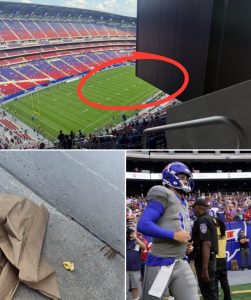
Associated Press journalist John Wawrow quickly went viral after posting a photograph from what he calculated to be the absolute worst seat in the house. From that specific vantage point, the far end zone simply does not exist, completely obstructed by the stadium’s structural geometry. The visual omission sparked immediate mockery online, with fans wondering how a spectator in that seat is supposed to witness a game-winning touchdown. Do they simply wait for the roar of the crowd, or do they find out what happened from the guy sitting directly behind them? While structural pillars, support cables, and obstructed views are a reality in almost every historic stadium in America, discovering a blind spot this severe in a brand-new, purpose-built $2.1 billion arena left a sour taste in the mouths of many.

Yet, the obstructed view paled in comparison to the structural oversight that fans discovered at the highest peaks of the stadium. Fans who made the long, grueling climb to the uppermost rows reported a baffling design omission: there is no bathroom up there. To make matters worse, there is no escalator system to help transport weary spectators back down to the main concourse level. After three full years of architectural drawings, blueprints, and executive reviews, it appears that nobody in the room stopped to ask about the basic human needs of the people sitting at the very top. Somebody looked at a $2.1 billion budget and apparently decided that those upper-deck fans could simply hold it for four quarters.

This logistical nightmare is especially painful considering the financial burden placed directly on the shoulders of the local community. Beyond the massive taxpayer subsidy, the legendary “Bills Mafia” paid an additional $263 million out of their own pockets in Personal Seat Licenses (PSLs) just for the privilege of securing those nosebleed seats. They paid premium prices to endure steep stairs, a lack of basic facilities, and a partial view of the field. In the end, the new Highmark Stadium is undeniably an elite football venue that will safeguard the team’s future in Buffalo, but the glaring upper-deck flaws serve as a stark reminder of the gap between executive promises and the actual fan experience. Every seat is great, Pete.